
D1.2 Report on Requirements and Specifications of the Overall Concept
The deliverable 1.2 of the RESTORE project aims to provide an extended definition of the RESTORE concept. The report provides information about the Requirements and Specification of the different innovative components presented in the RESTORE solution (especially the thermochemical storage system and the thermodynamic cycles).
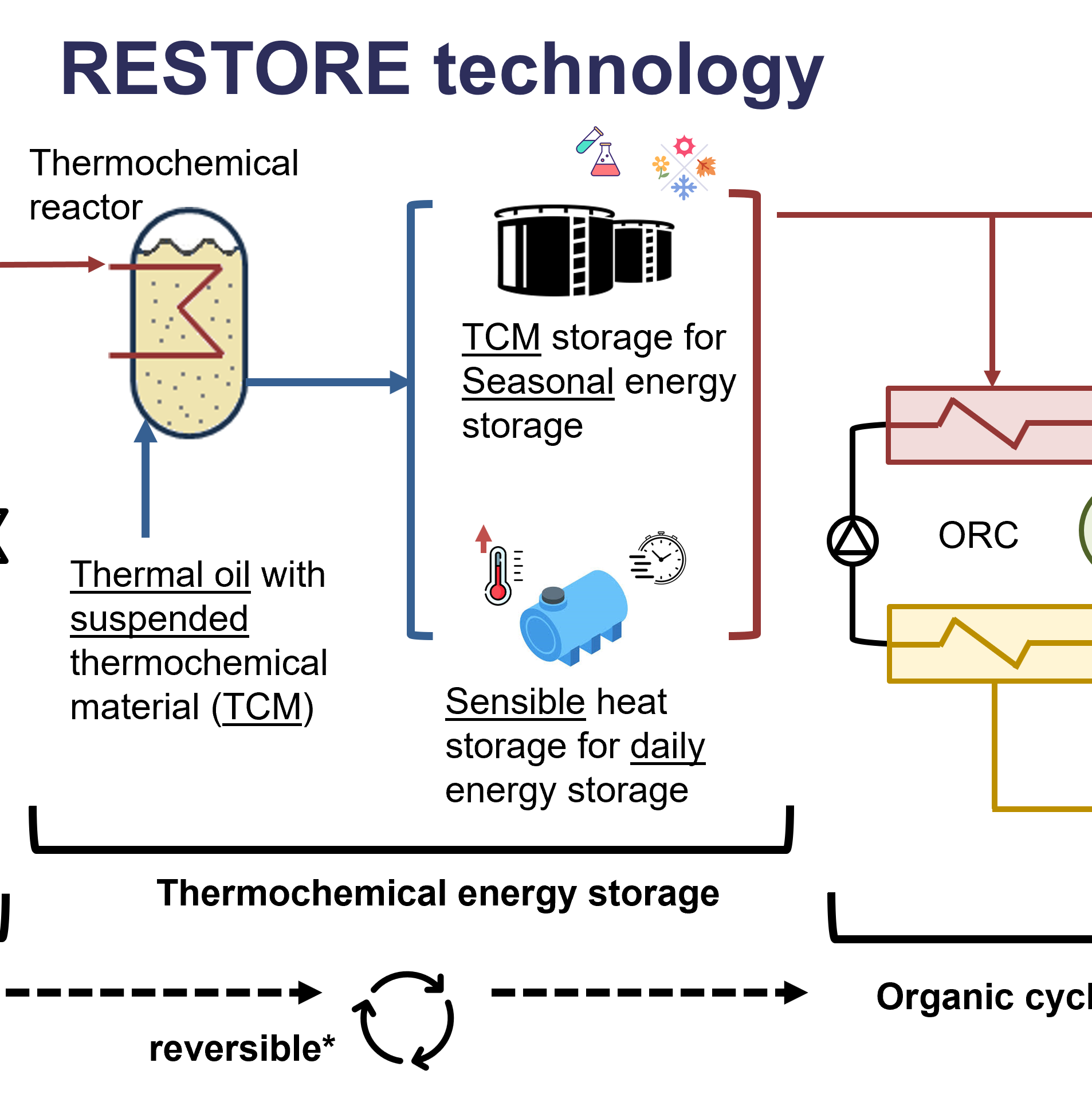
First, to set the context, the deliverable describes the RESTORE overall concept and its objectives in related to the storage and delivery of energy in both forms (heat
and electricity). Then, the deliverable is focused on the definition of the systems that born from the RESTORE concept which are related to the adaptation to the two main fields of applications, one dedicated to large scale applications, while the other focus on small scale applications. For each one, the deliverable provides an extend description, through the definition of the systems main components and its tables for specifications and requirements.
However, as the deliverable objective is to focus on the overall concept, the values of the specifications should be adapted, as ad-hoc solutions, considering the boundary conditions imposed by each specific application. In that context, the document provides the general bases of the concept that will be considered as a guide for potential future RESTORE system implementation at higher TRLs.
Full content & Contact details
The full content of Deliverable 1.2 is available here.
For further information concerning this deliverable, please contact:
Francisco Cabello
Centro Nacional de Energías Renovables (Fundación CENER)
fcabello@cener.com
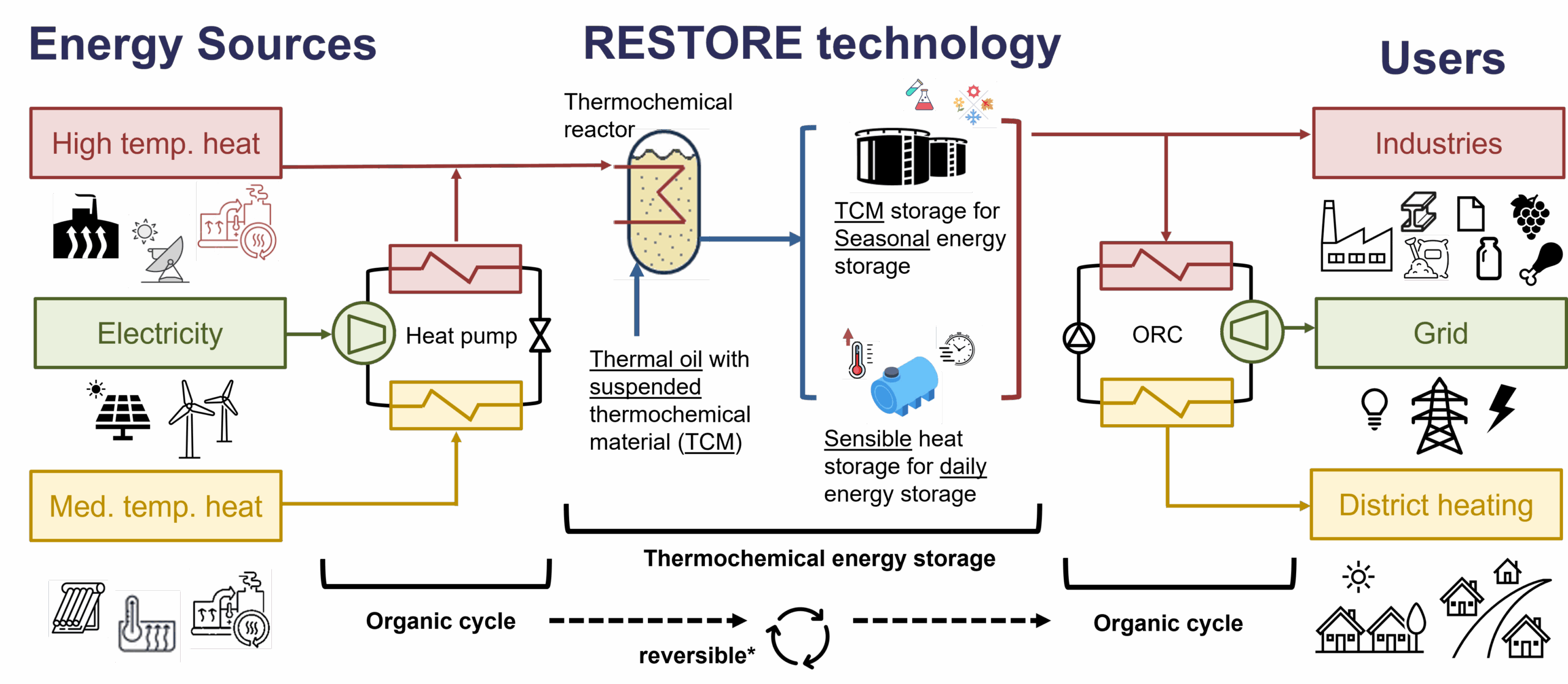
RESTORE overall concept
D1.4 Report on Specification of Use-Cases and models
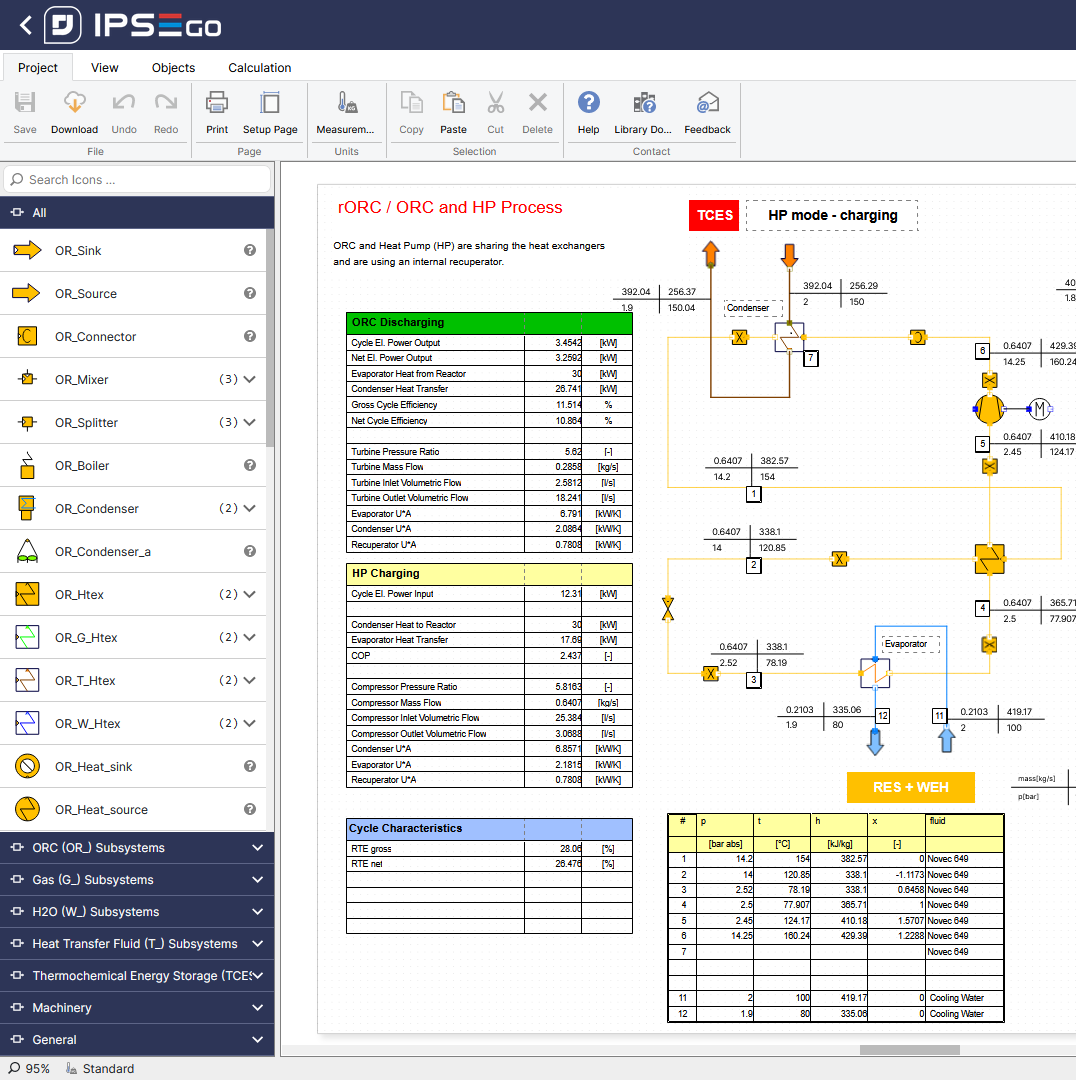
Deliverable D1.4 is the result of the work carried out in Task 1.4 “Specifications of RESTORE Numerical Models and Virtual Use-Cases for Simulation” of WP1 (RESTORE Requirements Definition, Specifications and Analysis). It describes the relevant specifications for the numerical models developed within RESTORE Project, giving emphasis to the models that are used in the six defined virtual use-cases for RESTORE. For this, D1.4 gathers specifications, such as feasible computational effort, compatibility between models, adaptability to the web-platform, modularity and flexibility.
The information provided here builds up on the general guideline of Deliverable D1.1 of the RESTORE overall concept, and focuses on its modelling, emphasizing the simulation concept of the project and the adaption of the simulation tools for the design of each Use-Case in an ad-hoc solution, considering the boundary conditions imposed by each specific application. In this context, the document provides the general basis to be considered as a guide during the project process modelling and use-cases implementation.
Full content & Contact details
The full content of Deliverable 1.4 is available here.
For further information concerning this deliverable, please contact:
Fatima Dargam
SimTech GmbH
f.dargam@simtechnology.com
Erhard Perz
SimTech GmbH
e.perz@simtechnology.com
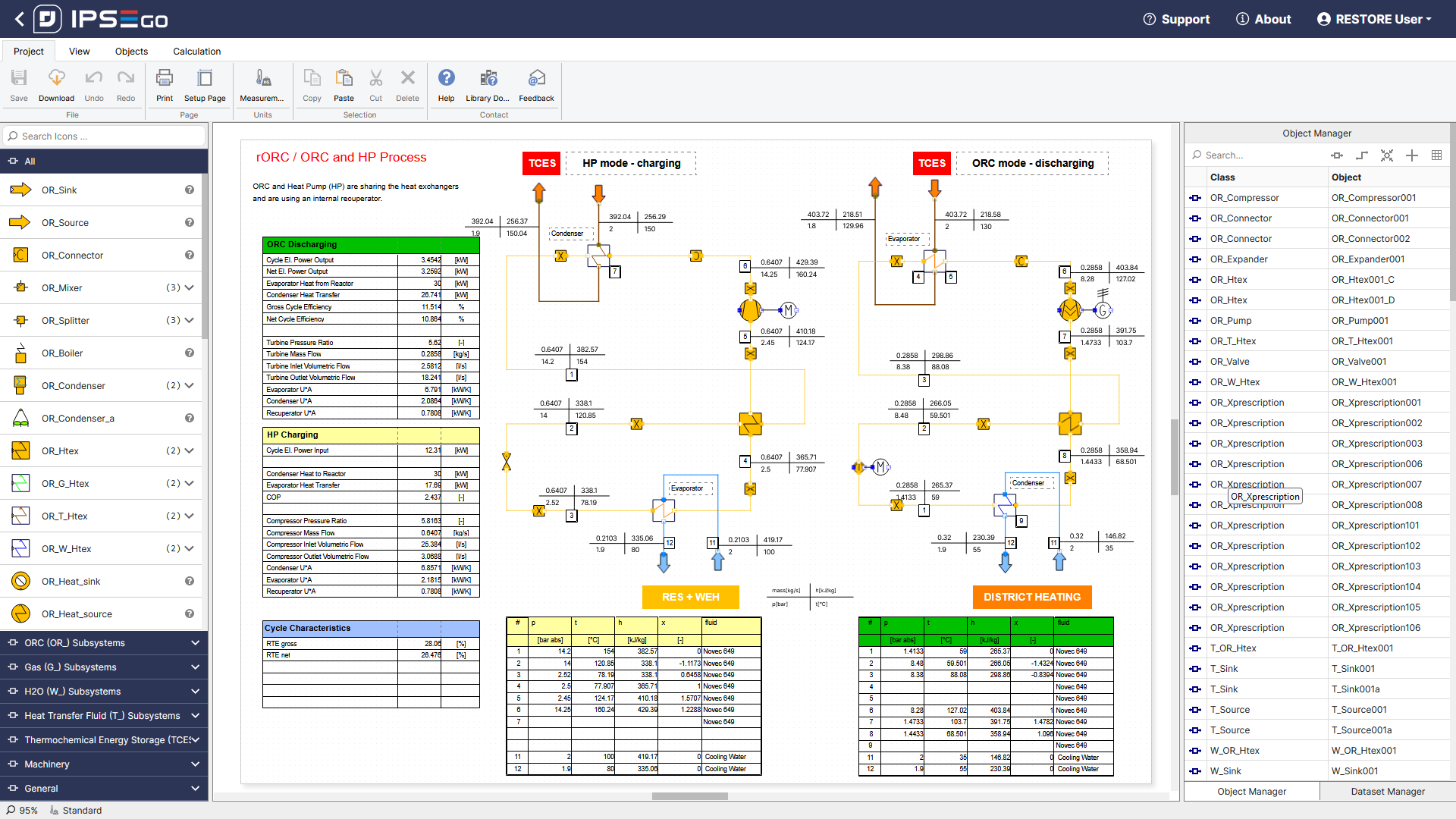
Figure: Modelling of an rORC process in IPSE GO
D1.6 Report on the assessment of the environmental sustainability (V1)
Deliverable 1.7 addresses the environmental assessment of six virtual use cases through the application of the Life Cycle Assessment (LCA) methodology. The main objective is to evaluate the integration of the RESTORE solution and renewable energy sources (RESs) within various plants connected to district heating and cooling (DHC) networks. The Use Case models combined with the RESTORE virtual tool, and developed on the IPSE Go platform, are based on data provided by the Use Case partners. additional details on the development of these models are available in Deliverables D5.4, D5.5, D5.6, D5.7, D5.8, and D5.9.
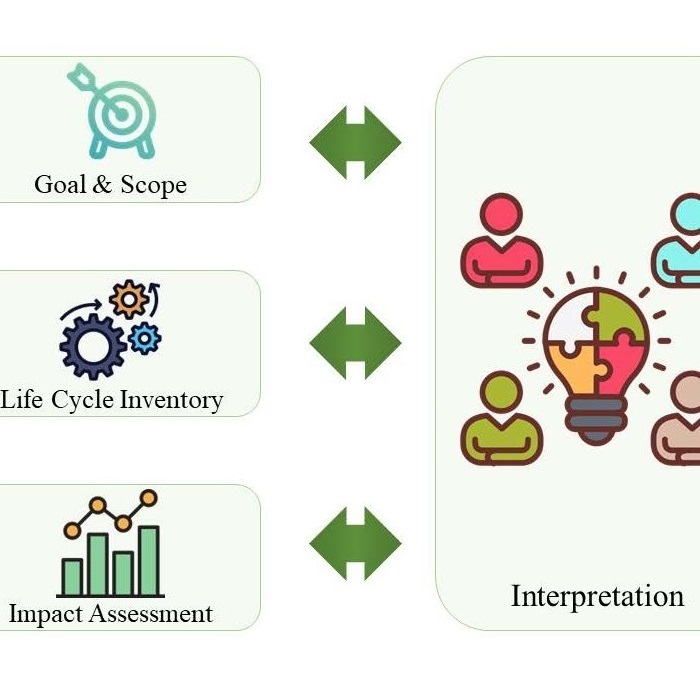
The LCA calculations are based on the mass and energy balance data obtained from both modelling activities and relevant scientific literature. The system boundaries considered in the LCA include: i) Upstream processes, such as raw material supply chains (e.g., organic fluids, Therminol V66, oil, copper sulphate), equipment manufacturing, and energy generation; ii) operational processes, including charging and discharging cycles; iii) Downstream processes, such as recycling and reuse of materials (e.g., organic fluids (Cyclopentane, NOVEC 649), Therminol V66, oil, copper sulphate), wastewater treatment (WWT), and final waste management.Conventional LCA methodology has been employed to comprehensively address each of the four LCA steps: 1) definition of the goal and objectives of the intended study; 2) Life Cycle Inventory (LCI) – building the input and output inventory; 3) Life Cycle Impact Assessment (LCIA) – impact evaluation step; and 4) Interpretation – analysing the results while providing recommendations to further enhance the overall performance of the system. The ReCiPe 2016 impact assessment method has been employed to perform the impact analysis during the LCIA stage by following the Hierarchist (H) cultural perspective. LCA for Experts software (formerly known as GaBi software) version 10.8 has been used throughout this investigation.
The results of the environmental analysis indicate that, during the charging phase, electricity is the dominant contributor to environmental impacts. It accounts for the highest share in both Global Warming Potential (GWP) and Fossil Depletion Potential (FDP), underlining the importance of increasing the use of RESs while reducing dependence on fossil-based resources. In the discharging phase, five out of six virtual use cases achieve negative emissions in GWP and FDP, primarily due to the electricity produced during this stage. The exception is Use Case VI, which shows positive emissions, largely explained by the significant contributions from the production of copper sulphate and organic fluid used. With respect to plant construction, the analysis reveals that its overall impact is considerably lower compared to the operational phases.
Further details on the main impact drivers across key environmental categories, along with recommendations to reduce the environmental footprint, are provided in the present deliverable.
Full content & Contact details
The full content of Deliverable 1.7 is available here.
For further information concerning this deliverable, please contact:
Letitia Petrescu
Universitatea Babeș-Bolyai
letitia.petrescu@ubbcluj.ro
Stefan Galusnyak
Universitatea Babeș-Bolyai
stefan.galusnyak@ubbcluj.ro
Alessandra-Diana Selejan-Ciubancan
Universitatea Babeș-Bolyai
alessandra.selejan@ubbcluj.ro
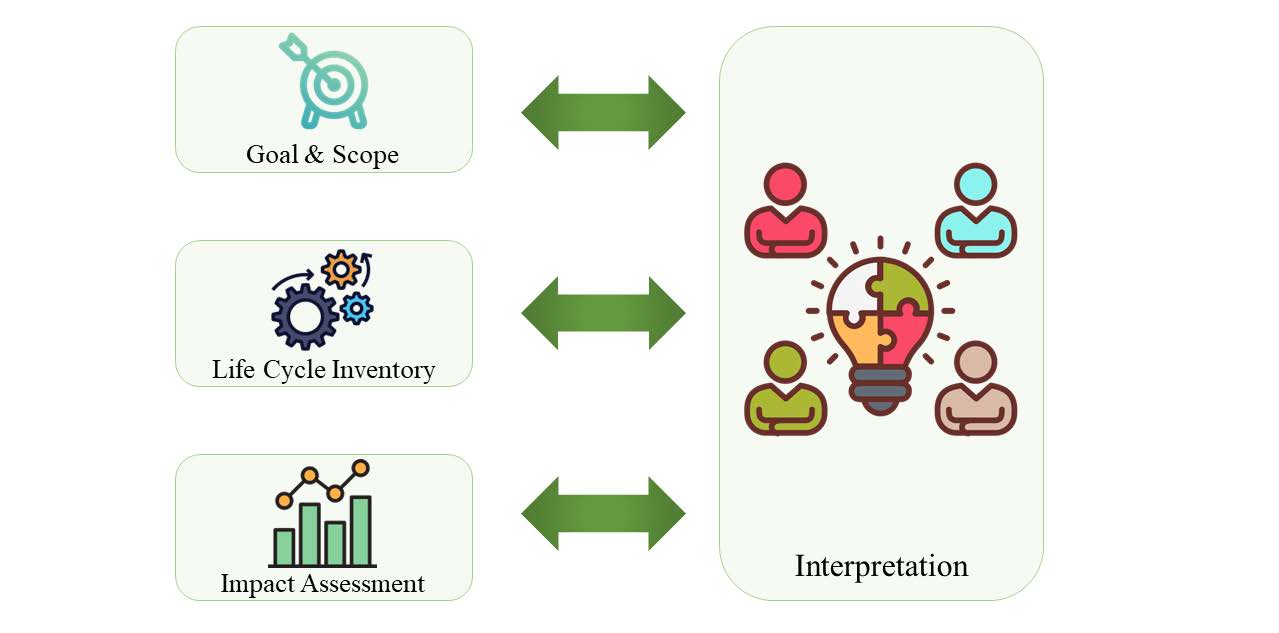
Figure: LCA methodology framework
D2.2 Design of a 1-2 kWth TCES reactor
The deliverable 2.2 of the RESTORE project is the result of Task 2.2 – “TCES small scale (1-2 kWth) continuous reactor design and manufacturing (M5-M12)” . It describes in detail the design of a 1-2 kWth continuously operated thermochemical energy storage (TCES) reactor.
This report is related to work package 2:
- “RESTORE High Energy-density Thermo-chemical Storage for daily and seasonal Energy Storage in DHC” as well as in combination with the further task in WP2, T2.1:
- “TCES conceptual design and batch type TCES experiments (M1-M18) ” and T2.3:
- “TCES small scale continuous reactor testing and optimisation (M13-M28)
It also provides the basis for designing and manufacturing a TCES reactor in the size of 30- 50 kWth in T2.4 – “Design of the 30-50 kWth /100-150 kWh TCES reactor for coupling with the thermodynamic cycle (M18-M28)”.
Scope of reactor experiments
Since the decision for a specific reaction system takes place at a later point of time, the focus during the engineering process of the continuous reactor was on its adaptability of it, to the requirements of the different reaction systems. That’s why, the main focus of this continuously operated reactor is, to investigate the continuous reaction of the different considered thermochemical energy storage systems and to identify the challenges, which could arise. In parallel, the essential framework conditions, e. g. heat transfer to/from the reactor, based on the flow structure of the suspension has to be analysed as well. For this task, a further reactor test stand was established, which allows performing experiments at different concentrations of solids and by using different stirrer types, as well as combinations of them.
In addition, Deliverable 2.2 introduces the test procedure of the experiments conducted in a lab-scale batch reactor. These experiments were used to test different thermochemical energy storage materials (TCM) and find the best available reaction system for the first scale-up step. Within the scope of task T2.1, there will be further investigation and optimising of the potential systems, and there will be a continued search for alternative systems to present the most suitable and final TCES reaction system in the report on deliverable 2.1 (M18).
Full content & Contact details
The full content of deliverable 2.2 is confidential.
For further information concerning this deliverable, please contact:
Prof. Andreas Werner
Technische Universität Wien
Department of Thermodynamics and Thermal Engineering
andreas.werner@tuwien.ac.at

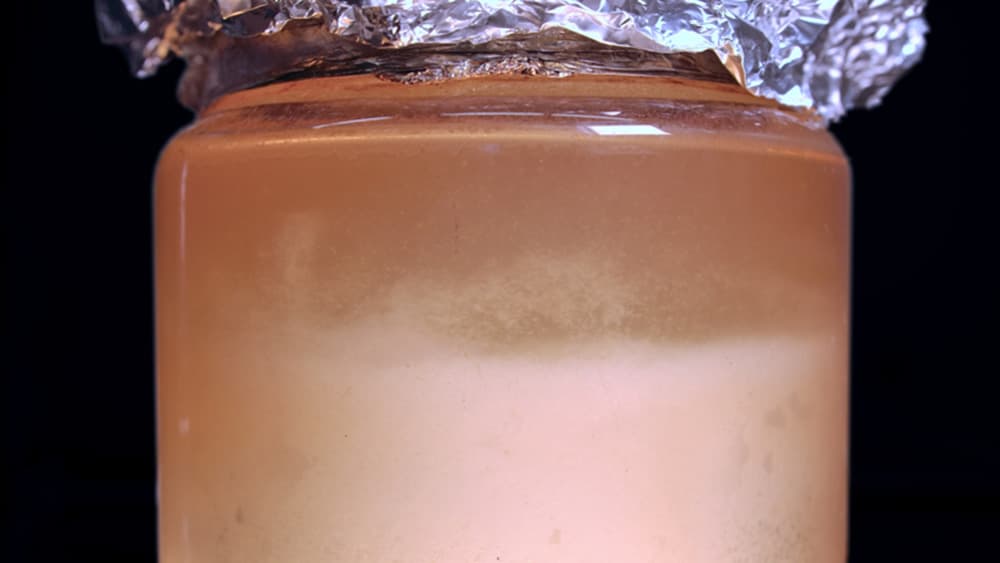
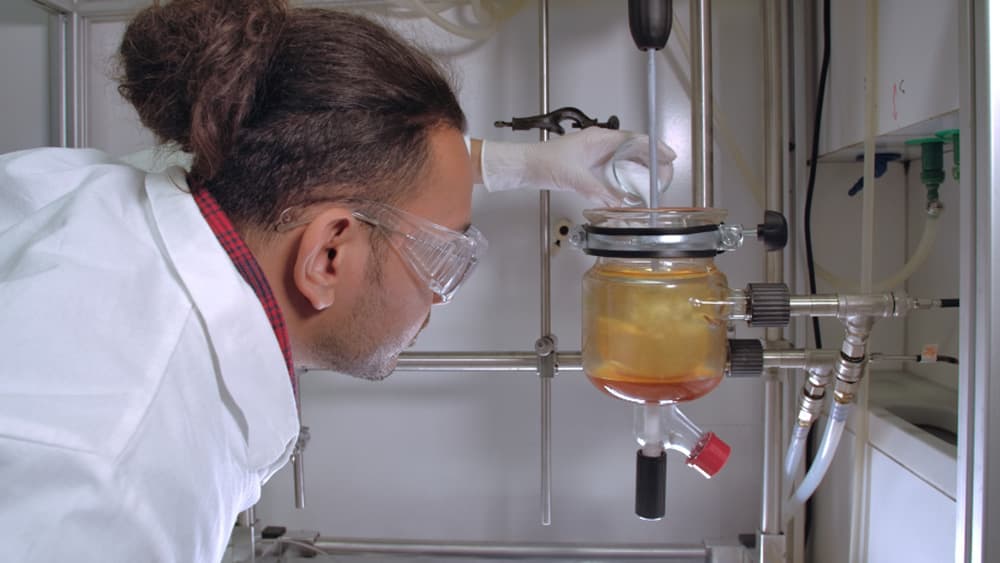
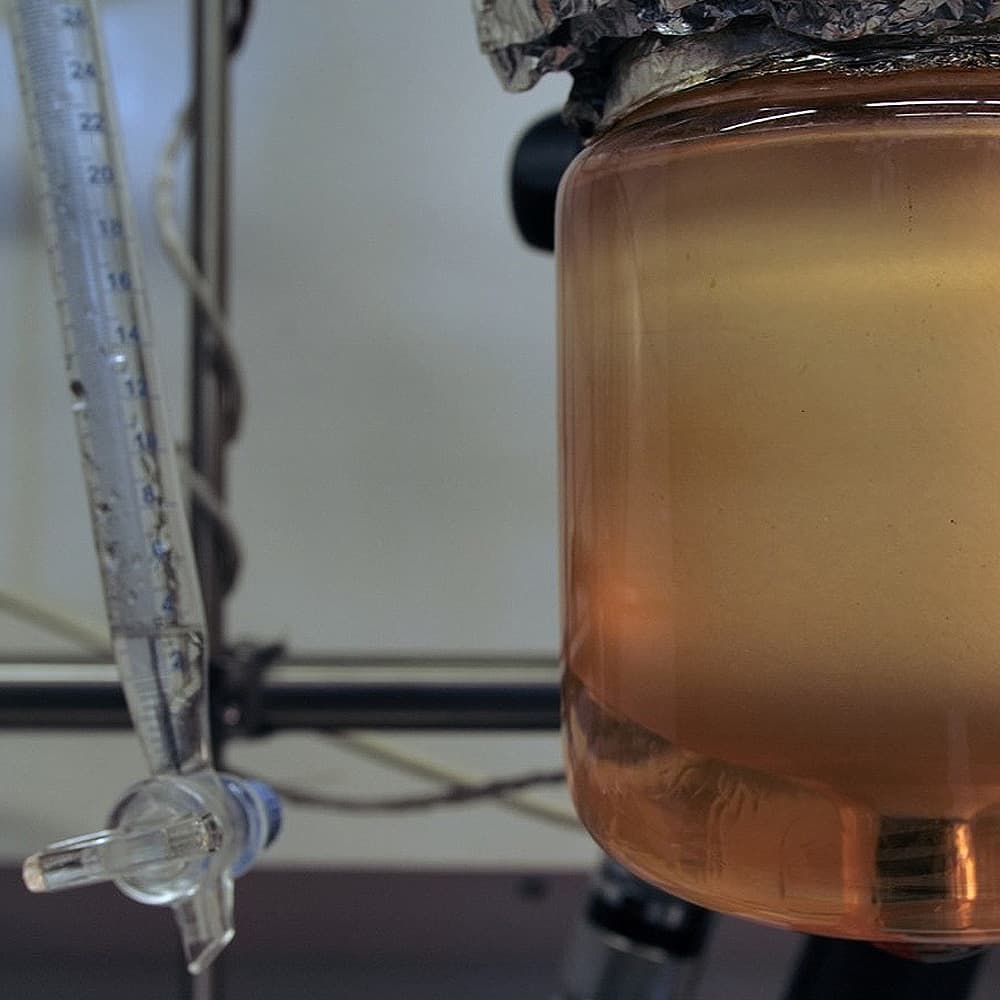
Photos of a thermochemical batch reactor by Alfred Zacharias
D2.6 Report on TCES upscaling
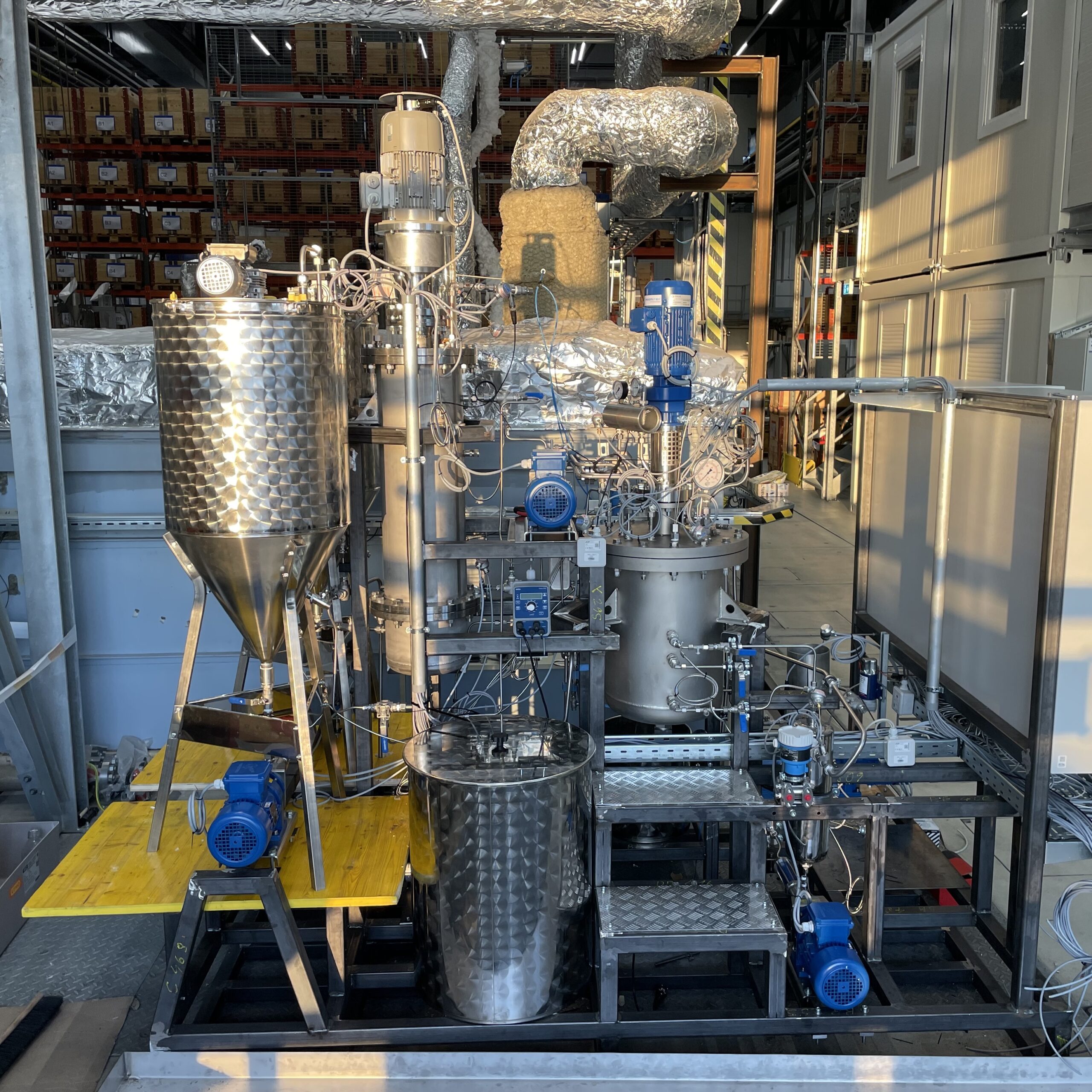
The upscaling and industrialization of a Thermochemical Energy Storage (TCES) system with the RESTORE concept from the laboratory pilot plant to large-scale commercial plants represents one of the most critical steps in further integration of renewable energy technologies, as it encompasses critical engineering challenges to reach higher TRLs at the same time with a promising pathway toward achieving high-density, long-duration energy storage with minimal thermal losses. To fulfil this task components design has to be performed thoroughly concerning almost every part of the whole system. Special attention has to be paid to the design and scale up of:
• the reactor with the stirrer and heat exchanger surfaces
• the lines to prevent blockage by the suspension
• the storage vessels for the different components (suspension, oil, water, nitrogen)
• the coupling to the HP/ORC
• the control devices
Full content & Contact details
The full content of deliverable 2.6 is available here.
For further information concerning this deliverable, please contact:
Prof. Andreas Werner
Technische Universität Wien
Department of Thermodynamics and Thermal Engineering
andreas.werner@tuwien.ac.at

5 kWth TCES continous reactor system
D3.1 Description of the numerical model for HP/ORC systems optimization and application to different test cases
The present deliverable presents the features, the operating principle and some results that can be obtained as a part of Task 3.1 – “Numerical model for optimal design of HP/ORC thermodynamic cycles ”. According to task description the Numerical model can perform the constrained optimization of the system investigating non-conventional plant configurations and selecting the most appropriate working fluid(s). A numerical model has been implemented in Python 3.7 and integrated with REFPROP 10 in order to ensure a high accuracy of working fluid thermodynamic properties calculation.
The numerical model is able to maximize system performance also providing a preliminary sizing of main components and techno-economic assessment based on RTE/Atot that has been identified as the most appropriate figure of merit for preliminary screening of fluids and cycle optimal parameters also accounting for the heat exchangers sizing. The numerical model is flexible and able to include different types of RES and technologies or WEH for providing heat (at high and medium temperature) and electricity. In addition to what was reported in the Grant Agreement the code is also able to investigate reversible, coupled and decoupled cycles and perform Pareto front analysis. Code structure and main features are all implemented, and the code will be further improved till the end of the project.
Full content & Contact details
The full content of Deliverable 3.1 is available here.
For further information concerning this deliverable, please contact:
Marco Astolfi
Politecnico di Milano
marco.astolfi@polimi.it
Dario Alfani
Politecnico di Milano
dario.alfani@polimi.it
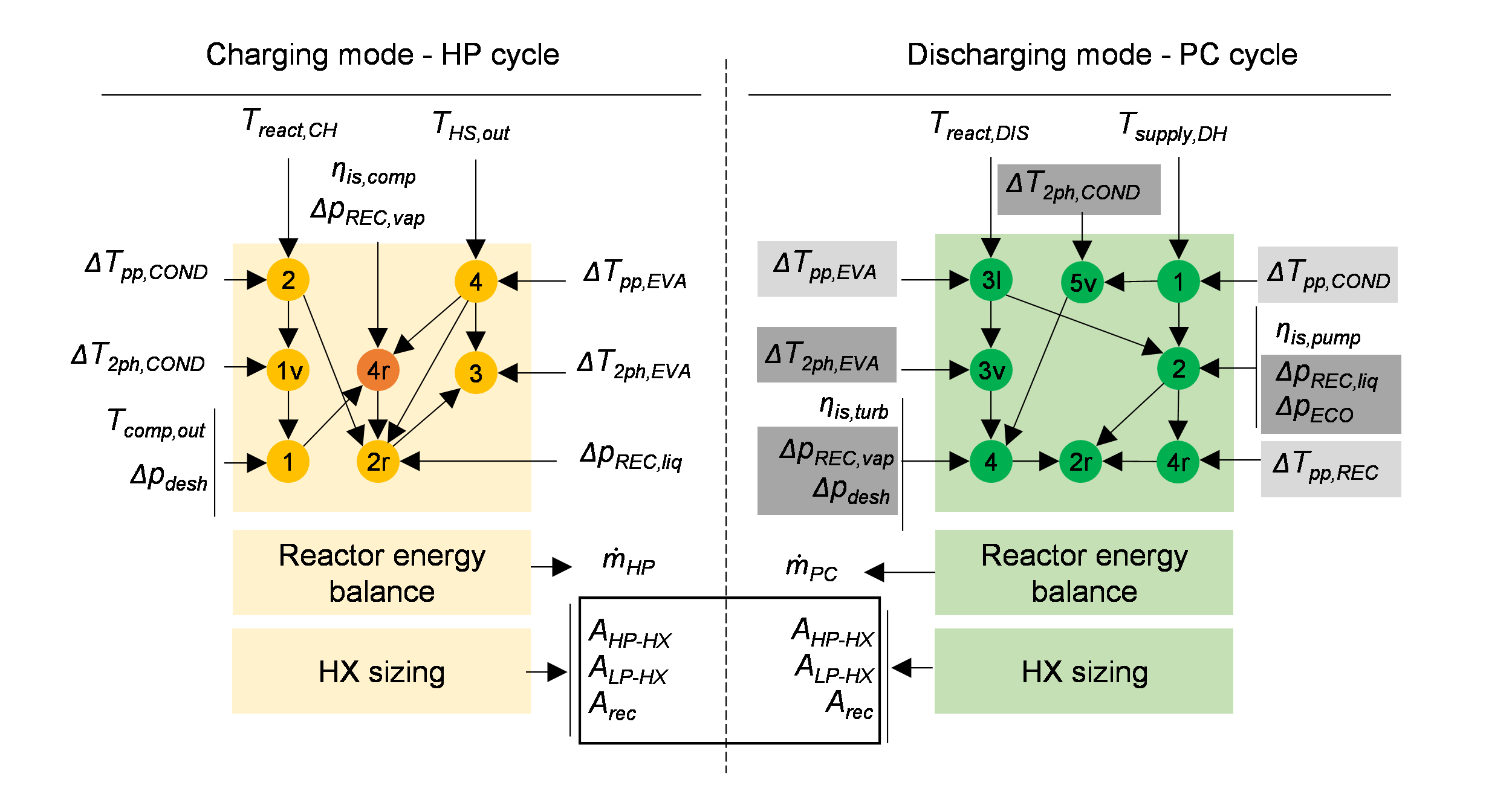
Figure: Solving scheme for the heat pump (HP) (left) and power cycle (PC) (right)
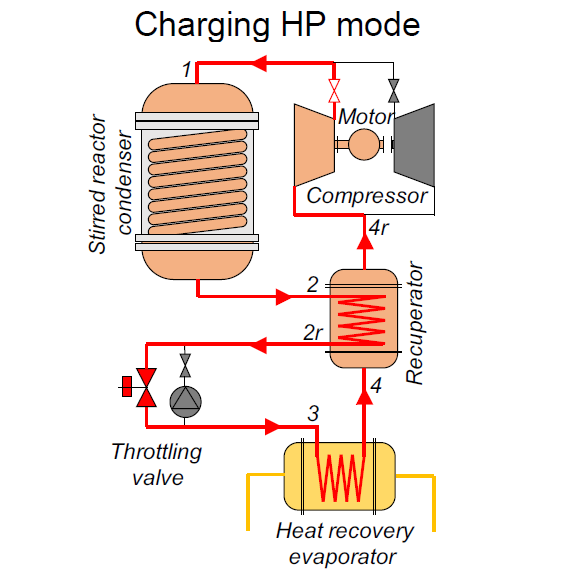
D3.4 Report on part load and off design performance of PTS system
In this deliverable, the off-design and part-load behaviour of the RESTORE system is investigated in a wide range of operating conditions such as the variation of the thermochemical storage temperatures and thermal power, stirred reactor heat transfer coefficient, and heat source and district heating water temperature and mass flow rate variations.
For each analysis the deviation of heat pump COP and power cycle efficiency from the nominal values is reported explaining the main causes affecting their departure form nominal values. The analysis is carried out considering the variation of each parameter independently of the other ones, which are kept equal to their nominal value. This method allows to clearly identify the potential effects cause by the variation of specific conditions. The functions obtained are indicative of some specific conditions that are not representative of a realistic plant operation, where usually the variation of many parameters are combined together. The impact of the simultaneous variation of boundary conditions can be obtained by sum of the different effects as usually done during acceptance test of power plants.
This method is a simplification and approximation of the real off design behaviour of the system due to non-linear interaction between parameters and shall be then considered as a first estimation for the evaluation of operability range. Specific conditions can be then precisely evaluated with dedicated runs of the developed code that can perform simulations of both the heat pump and the ORC cycle in a large envelope in any combination of exogenous parameters. Obtained results are clearly dependent on the working fluid choice and the nominal design of the system (size of the heat exchangers, temperature lift etc).
Full content & Contact details
The full content of Deliverable 3.4 is confidential.
For further information concerning this deliverable, please contact:
Marco Astolfi
Politecnico di Milano
marco.astolfi@polimi.it
Dario Alfani
Politecnico di Milano
dario.alfani@polimi.it
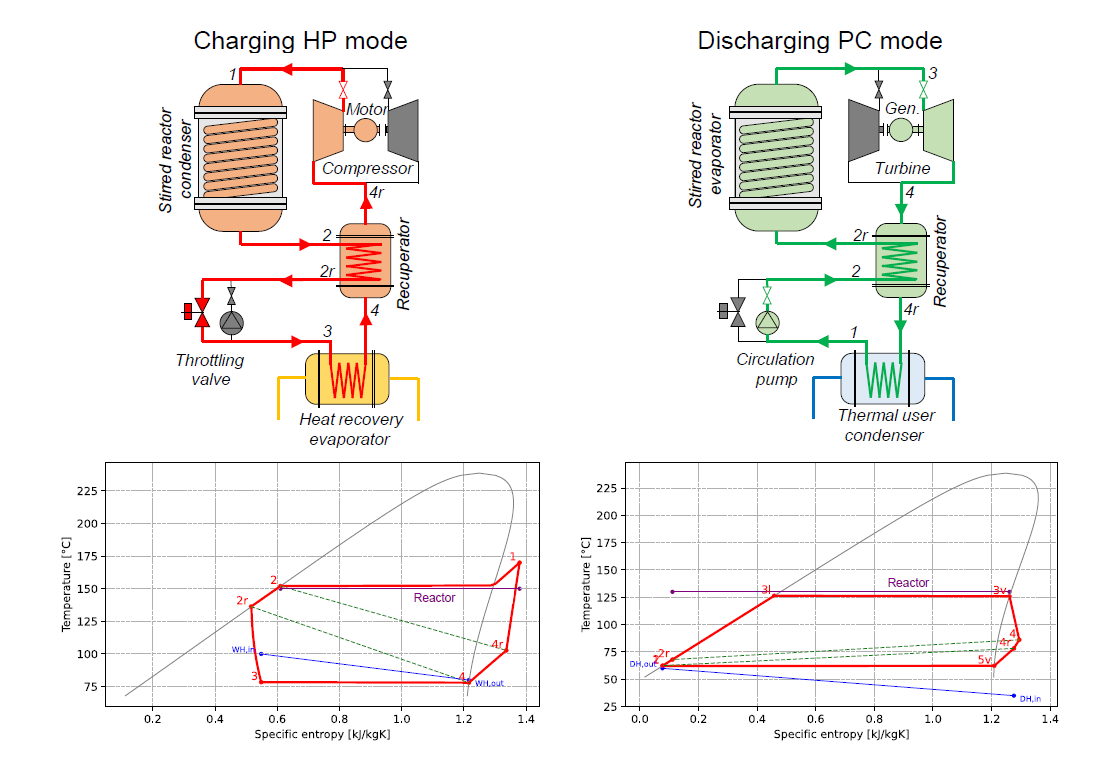
Figure: (top) Coupled Cycles Configuration Scheme Adopting Reversible Heat Exchangers, (bottom) T-s Diagrams For (left) Charging and (right) Discharging Cycles Using Cyclopentane in Coupled Cycle Configuration.
D5.11 RESTORE Replication Strategy V2
Deliverable 5.11 provides information about the RESTORE project’s EU-wide replication strategy from task T5.5 on “Replication Strategy via Stakeholders additional Cases”, led by SIMTECH and PI. Results of task T5.5 were initially reported in the WP5 deliverable D5.10 (V1) in month M26 [11], and also in the current deliverable D5.11 (V2), in M48.
Deliverable D5.11 was produced by SIMTECH, and reports the result of the complete work carried out in T5.5 during the period of M9 to M48 of the project, from the description of the specified replication strategy to motivate RESTORE’s stakeholders to create additional cases and trials during and after the project lifetime, using the RESTORE Virtual Tool powered by the IPSE GO simulation web-platform. The creation of stakeholders’ additional test-cases were encouraged to be based on the six RESTORE virtual use-cases, developed in WP5 task T5.4 (Implementation, Optimization, Management & Validation of RESTORE Use-Cases using the Simulation Web Platform).
The information provided in this document builds upon collaboration between SIMTECH and PROSPEX Institute (PI), with contributions from other RESTORE partners, considering inputs from WP1, WP6, and WP7 among others.
Full content & Contact details
The full content of Deliverable 5.11 is available here.
For further information concerning this deliverable, please contact:
Fatima Dargam
SimTech GmbH
f.dargam@simtechnology.com
Erhard Perz
SimTech GmbH
e.perz@simtechnology.com

Figure: RESTORE Replication Strategy Dependency
D5.1 Modelling of individual component models of the overall RESTORE system and its techno-economic simulation (V1)
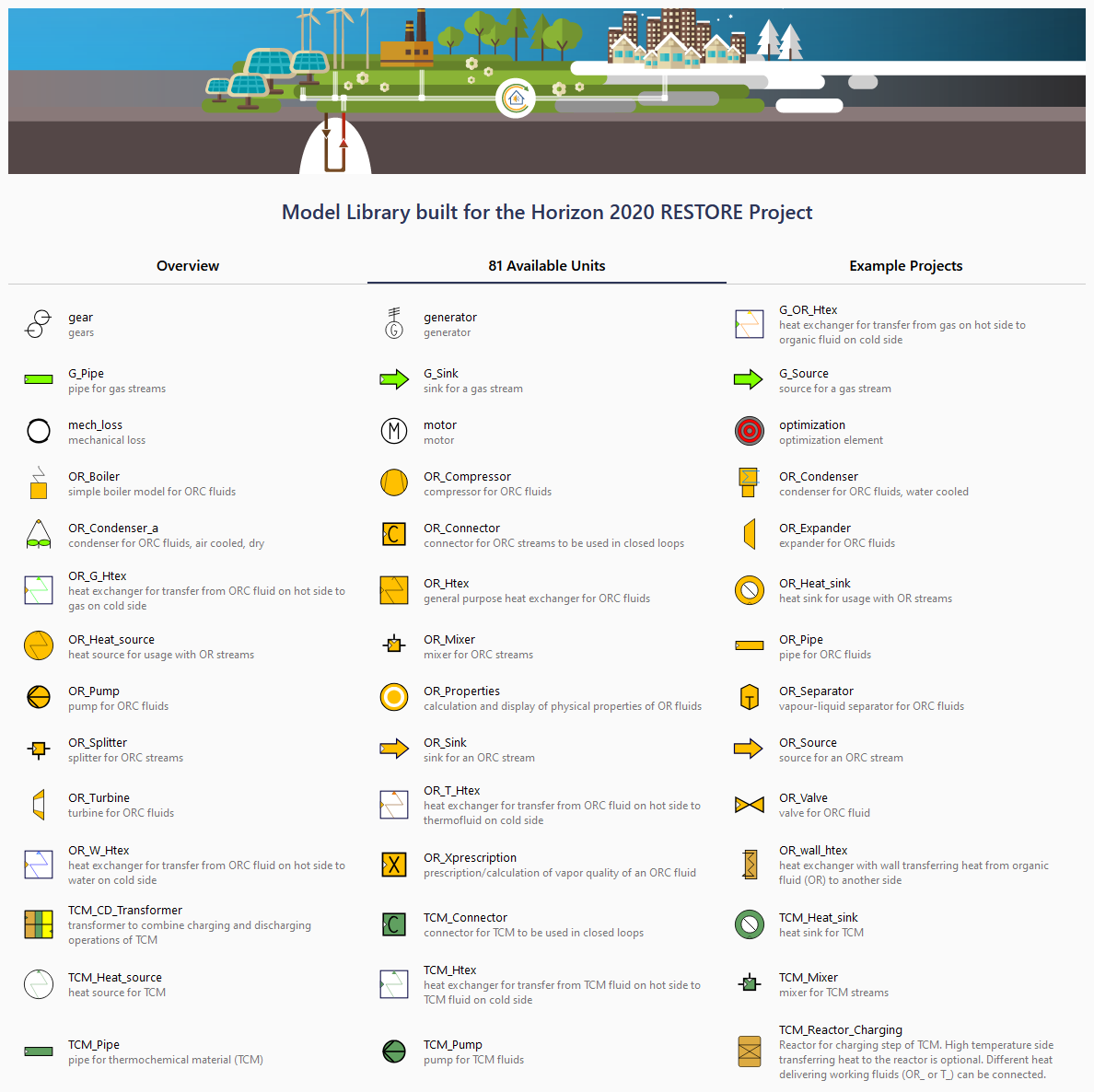
This document provides information about the modelling of individual components of the overall RESTORE system. Deliverable D5.2 is the result of the work carried out in task T5.2 (RESTORE techno-economic modelling of the integrated system, M9-M47), led by CENER, initiated in task T5.1 (Modelling of individual components of the overall RESTORE system, M7-M30), led by SIMTECH. The main purpose of this report is to describe the final version of the component models developed for the dedicated model library RESTORE_Lib, and to describe the process level of the overall RESTORE model, based on the TCES and on the rORC technologies, with the economic modelling of the system.
Task T5.2 developed the project required models for system level simulation (yearly performance simulations, covering off-design performance of cycles and constraints due to transient behaviour) and for techno-economic analysis. The RESTORE sub-systems, with TCES and rORC technologies, were modelled using the customized RESTORE_Lib model library created in T5.1, enhanced with additional economic parameters, that are cost-correlations of the investment costs for the components. The systems were tested and optimized within the process simulation environment within the RESTORE virtual tool, powered by the IPSE GO web-platform.
The economic model considered in the project is highly flexible, allowing the user to modify a high number of parameters that are considered for the economic simulations. In addition, the model receives information from the technical simulation to show as results relevant economic variables such as the Net Present Value, the Internal Return Rate and the Levelized Cost of Storage for Electricity and Heat. The information provided in this document builds upon collaboration between SIMTECH, CENER, TU-WIEN, and POL, as RESTORE partners involved in task T5.2. The development of task WP5-T5.2 received input from WP1-T1.4 & T1.7, WP2, WP3, WP4, and from WP5-T5.1, T5.4, T5.5.
Full content & Contact details
The full content of Deliverable 5.1 is available here.
For further information concerning this deliverable, please contact:
Stefan Bergmann
SimTech GmbH
s.bergmann@simtechnology.com
Fatima Dargam
SimTech GmbH
f.dargam@simtechnology.com
D5.3 Web-Platform adaptation for RESTORE dynamic and techno-economic modelling to represent different Use-Cases
Deliverable 5.3 provides information about the adaptation of the IPSE GO Web-Platform for RESTORE dynamic and techno-economic modelling to represent the six different Use-Cases defined in the project. Deliverable D5.3 is the result of the work carried out in task T5.3 led by SIMTECH, during the period of month M1 to M40 of the project. The main purpose of this report is to describe the development needed to adapt the simulation platform IPSE GO for using the steady-state IPSEpro process models to properly present the results for the RESTORE transient models via a web browser. Hence, D5.3 describes the implementation performed by SIMTECH in the web-platform to support dynamic modelling, as well as the evaluation of main economic parameters to make the techno-economic analysis of the
RESTORE project possible in IPSE GO.
The information provided in this document builds upon collaboration between SIMTECH, CENER, TU-WIEN, and POLIMI, as RESTORE partners involved in task T5.3. Task T5.3 receives input from WP5 tasks T5.1, T5.2 and from WP1-T1.4 relative to the specification of the Use-Cases for simulation. In this sense, besides D5.3’s central scope on the adaptation of the IPSE GO Web-Platform for RESTORE dynamic and techno-economic modelling, using SIMTECH’s simulation tools, it also considered the outcomes published so far in the deliverables of WP1, WP2, WP3 and WP5.
Full content & Contact details
The full content of Deliverable 5.3 is available here.
For further information concerning this deliverable, please contact:
Erhard Perz
SimTech GmbH
e.perz@simtechnology.com
Simon Kysela
SimTech GmbH
simon.kysela@simtechnology.com
Markus Perz
SimTech GmbH
markus.perz@simtechnology.com
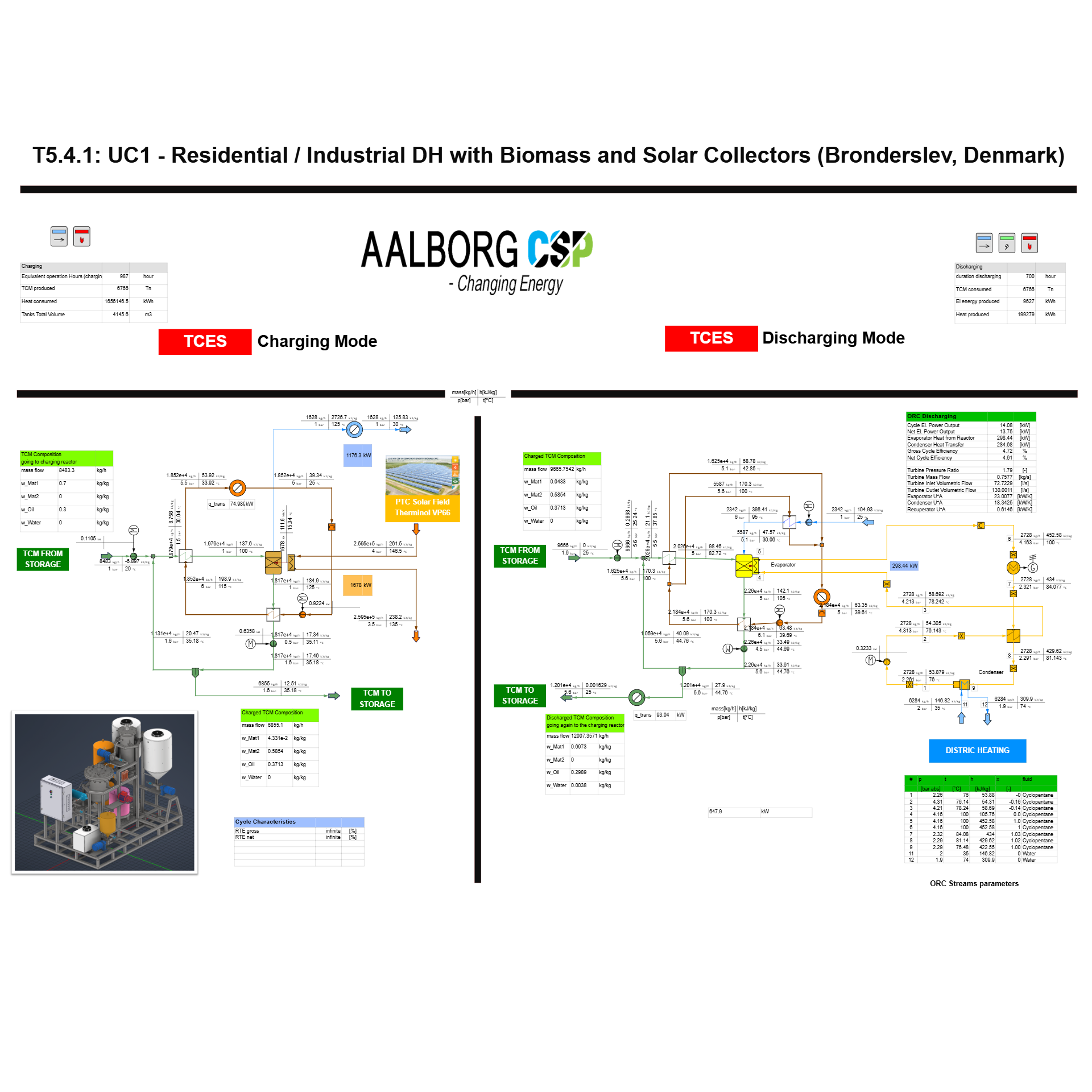
WP5-Task T5.4 RESTORE Use-Cases Modelling Summary
This report summarizes the development of WP5 task T5.4 on “Implementation, optimization, management & validation of RESTORE Use-Cases using the Simulation Web Platform”, led by SimTech with close cooperation with the Use-Cases Providers.
This report supports Results of task T5.4 reported in month M46 of RESTORE project, via the following Deliverables that are available on our Zenodo repository:
• D5.4: Implementation and validation of RESTORE Use-Case I: Residential / Industrial DH with Biomass and Solar Collectors.
• D5.5: Implementation and validation of RESTORE Use-Case II: Integration of different heat sources in DH of Cement Industry.
• D5.6: Implementation and validation of RESTORE Use-Case III: Integration of different heat sources in DH of Paper Mills Industry.
• D5.7: Implementation and validation of RESTORE Use-Case IV: Integration of different heat sources in DH of Steel-working industry.
• D5.8: Implementation and validation of RESTORE Use-Case V: District heating with Geothermal Technology.
• D5.9: Implementation and validation of RESTORE Use-Case VI: Small-scale DHC network of Politecnico di Milano campus.
The main purpose of this report (in version 1.0) is to describe the preliminary specifications for the six Use-Cases modelling, within the RESTORE virtual tool powered by the IPSE GO simulation web-platform.
The information provided in this document builds upon collaboration between SimTech and all RESTORE development partners, in the sense that it considers inputs not only from other tasks of WP5, but also from work packages WP1, WP2, WP3 and WP4.
Full content & Contact details
The full content of this report is available here.
For further information concerning this report, please contact:
Fatima Dargam
SimTech GmbH
f.dargam@simtechnology.com
Erhard Perz
SimTech GmbH
e.perz@simtechnology.com
Stefan Bergmann
SimTech GmbH
s.bergmann@simtechnology.com
D6.5 Report on technology watch and market evaluation
The report on technology watch and market evaluation of the RESTORE project is the related to Task 6.2.1 – Technology watch. The first version of the report was published in deliverable 6.5, which will be updated in a 12-months period.
The main objectives of the report are:
- to give an overview about long term energy storage, concerning the concept of pumped thermal energy storage (PTES). Some considerations about the RESTORE concept, the architecture of the power cycle and organic working fluids are included. Furthermore the main players on the European market are listed.
- the technology watch, which can be subdivided into a patent- and a trademark-search, taking under consideration relevant literature and ongoing research activities.
- the market analysis, which consists of two major points:
– the preparatory phase, comprising the identification of key exploitable results
– the methodological approach to the market analysis, describing tools, a questionnaire and workshops
Full content & Contact details
The full content of Deliverable 6.5 is confidential.
For further information concerning this deliverable, please contact:
Lucia Hörner
Steinbeis Europa Zentrum
lucia.hoerner@steinbeis-europa.de
D6.11 Report on regulations & standards for wide replication along EU
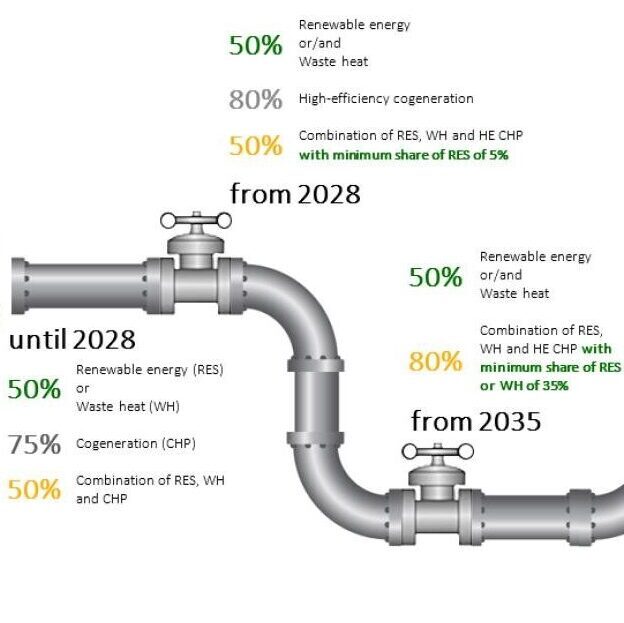
The present deliverable is the basis for an overview about the European legislation and standardization. This report analyses existing regulations and standards impacting the wide replication of innovative district heating and cooling (DHC) technologies across the European Union (EU).
The report highlights recent revisions to the EU Energy Efficiency Directive (EED) and Renewable Energy Directive (RED), both of which strengthen the role of renewable energy sources (RES) and waste heat recovery in DHC systems. Also biomass has been considered in the RED analysis as potential renewable energy sources applicable for RESTORE project.
Key takeaways include:
• Increased EU targets for energy efficiency and RES use.
• New definition of efficient DHC that considers both RES and waste heat.
• Recognition of waste heat as a renewable energy source throughout the EED.
• Binding targets for the share of renewables in heating and cooling, with a specific focus on increasing RES in DHC networks.
• Measures to accelerate the deployment of RES and waste heat for heating and cooling.
The report examines the EU Taxonomy, a classification system that defines environmentally sustainable economic activities and also includes an overview about the European legislation, the main barriers and solutions to overcome them.
Full content & Contact details
The full content of Deliverable 6.11 is available here.

Figure: New EDHC timeline
For further information concerning this deliverable, please contact:
Nazarena Spinelli
Turboden S.p.A
nazarena.spinelli@turboden.it
This page lists the public deliverables published in RESTORE. Additionally, all public deliverables are uploaded to a Zenodo repository.
D1.2 Report on Requirements and Specifications of the Overall Concept
The deliverable 1.2 of the RESTORE project provides an extended definition of the RESTORE concept, providing information about the Requirements and Specification of the different innovative components presented in the RESTORE solution.
D1.4 Report on Specification of Use-Cases and models
The deliverable 1.4 describes the relevant specifications for the numerical models developed within RESTORE Project, giving emphasis to the models that are used in the six defined virtual use-cases for RESTORE.
D1.7 Report on the assessment of the environmental sustainability (V2)
The deliverable 1.7 addresses the environmental evaluation of the concept that was carried out through the RESTORE project utilizing the Life Cycle Assessment (LCA) methodology for the RESTORE Prototype.
D2.2 Design of a 1-2 kWth TCES reactor
The deliverable 2.2 of the RESTORE project is the result of Task 2.2 – “TCES small scale (1-2 kWth) continuous reactor design and manufacturing (M5-M12)” and describes in detail the design of a 1-2 kWth continuously operated thermochemical energy storage (TCES) reactor elaborated by TU Wien.
D2.6 Report on TCES upscaling
The deliverable 2.6 presents the component design of the 5kW TCES reactor giving special attention on the stirrer and heat exchanger surfaces, the lines to prevent blockage by the suspension, the storage vessels for the different components, the coupling to the HP/ORC and the control devices.

D3.1 Description of the numerical model for HP/ORC systems optimization and application to different test cases
The deliverable 3.1 describes the numerical model for HP/ORC thermodynamic cycles within the RESTORE project, emphasizing the features, operating principles, and the potential results obtainable through its application in different test cases.
D3.4 Report on part load and off design performance of PTS system
The deliverable 3.4 uses the numerical model developed in T3.1 to investigate the RESTORE system in a wide range of operating conditions by quantifying the off-design performance of the HP and ORC thermodynamic cycle as function of variation of boundaries conditions.

D5.2 Modelling of individual component models of the overall RESTORE system and its techno-economic simulation (V2)
The deliverable 5.2 describes the dedicated component models contained in the model library RESTORE_Lib built in task T5.1 and T5.2 led by SIMTECH. It also presents the economic model considered in this project.
D5.3 Web-Platform adaptation for RESTORE dynamic and techno-economic modelling to represent different Use-Cases
The deliverable 5.3 provides information about the adaptation of the IPSE GO Web-Platform for RESTORE dynamic and techno-economic modelling to represent the six different Use-Cases.
WP5-Task T5.4 RESTORE Use-Cases Modelling Summary
This report contains general information about “RESTORE Use-Cases Modelling”, related to WP5 Task T5.4, dealing with implementation, optimization, management & validation of the six RESTORE Use-Cases, using the Simulation Web Platform.
D5.11 RESTORE Replication Strategy V2
The deliverable 5.10 describes the preliminary replication strategy specification to allow and motivate RESTORE’s stakeholders to create additional cases and trials during and after the project lifetime, within the RESTORE virtual tool powered by the IPSE GO simulation web-platform.

D6.5 Report on technology watch and market evaluation
The report on technology watch and market evaluation of the RESTORE project is the related to Task 6.2.1 – Technology watch. The first version of the report was published in deliverable 6.5, which will be updated in a 12-months period.
D6.11 Report on regulations & standards for wide replication along EU
The deliverable 6.11 summarizes the work carried out in the task 6.4: Regulations and Standards for EU-wide replication and provides information to have a better understanding of the regulatory framework for the RESTORE solution.